

It's an exciting time to build software. AI has made it possible for almost anyone to go from idea to a working app faster than ever before, and that's genuinely a wonderful thing.
But as a mobile app development agency that works closely with brands, we've been thinking a lot about what this shift really means. Not just for how apps get built, but for the kind of expertise that makes them truly great.
As we've worked with AI-assisted workflows internally, we've noticed an important distinction emerge. Some approaches optimize for momentum — getting from idea to interface as quickly as possible. Others optimize for durability — creating software that's maintainable, scalable, and grounded in deliberate technical decisions.
And that distinction matters more than some might realize.
Two Very Different Ways to Build With AI
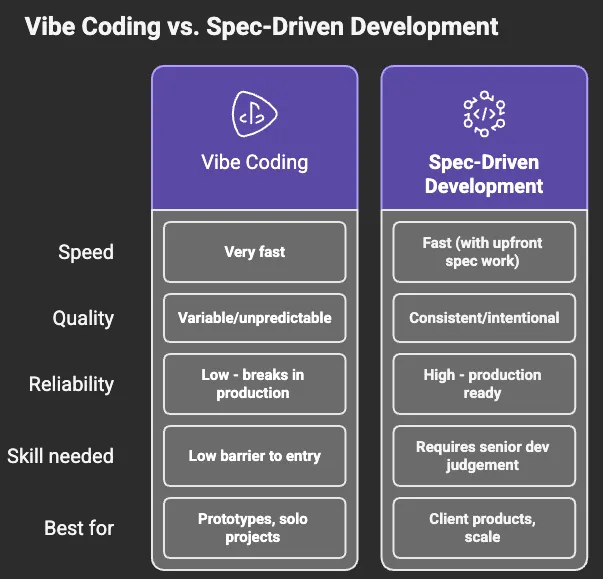
Vibe Coding
Vibe coding is wonderfully freewheeling. You describe what you want in broad strokes, and the model figures out the rest. No spec needed, no endpoint defined — just a prompt and a result.
• The model draws on billions of patterns to produce something that “feels right”
• It's fast, low-friction, and perfect for early exploration
• Great for prototypes, personal projects, and quick experiments
Where it gets tricky is when your vibe-coded prototype needs to become a product. Without defined requirements, validation rules, or edge case handling, there's a real chance the app works beautifully in a demo and stumbles in the hands of real users.
Spec-Driven Development
Spec-driven development gives AI what it needs to do its best work: clarity.
Instead of leaving things open-ended, a developer works with the agent to define the full picture before a line of code is written. When someone says "build a /signup page", a well-configured agent will thoughtfully ask:
• Is this a new feature, a bug fix, or a chore?
• What endpoint should this connect to?
• Which design system components should be used?
• What validation rules and error states apply?
• What test cases should we write?
The result is code that's grounded in real decisions, not just the most statistically likely answer. It's a genuinely collaborative process, and it produces products your brand can be proud of.
Where Experienced Developers Make All the Difference
Here's the thing about spec-driven development: It's only as good as the specs. And writing specs that are complete, thoughtful, and aware of downstream consequences takes real experience.
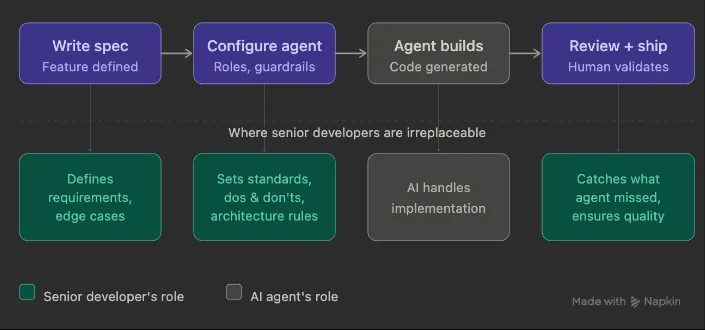
Before an agent can be trusted on a codebase, a senior developer needs to set it up well, defining:
• Its role and where its responsibilities begin and end
• The coding standards and architectural patterns it should follow
• What it can handle independently and what needs a human in the loop
• How to approach security, error handling, and data contracts
This kind of setup draws on years of hard-won knowledge. The kind you build by living with architectural decisions over time, by having shipped things that needed to hold up under pressure.
At Heady, our developers bring that depth to every project.
They can configure the agents, guide the process, and review the output to make sure everything meets the standard our brand partners expect.